
The Animals and the Angels
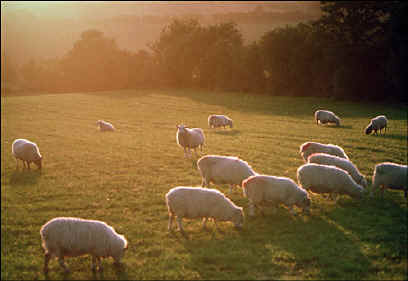
The community in which I live is located in an open, parklike area of great beauty, a space we share with many birds, lizards, rabbits and ground squirrels. Each time I take a walk, I will see some of them--flying or perched, eating, on sentry duty, singing or giving alarm, emerging from or disappearing into dens and nests. I often stop for a brief moment of wonder and delight as I look into their dark eyes and bless them.
But at night, and occasionally also in daylight, there are also the coyotes. Sometimes there are howls which I always feel are expressions of hunger, not only of the body’s hunger for the food that perishes, but the soul’s hunger for the food that leads to eternal life. (For from where did they come, but from the divine Source? Is it not possible that at some deep level they feel it and thirst painfully for the fullness of that Life?) And occasionally there will be a fierce outburst of many coyotes yammering together as (I suppose) they tear apart a rabbit or squirrel they found abroad or dug out of his or her underground nest. Then what can a compassionate listener do except pray--pray that the consciousness of the anguished victim be received into the Light, that the coyotes will evolve beyond the bloodlust that curses them as well as their victims?
I find that William Blake’s “Night,” the poetry selection for this month, gives voice to these very concerns. The time is nightfall, the setting is evidently a rural scene in England’s green and pleasant land. A living moon watches the beautiful landscape and smiles with delight. The innocents are birds and sheep, the predators are wolves and tigers. (English tigers?) But there is another, major party in this scene that is probably seldom in the thoughts of friends of animals today, and that is angels. (This is, after all, William Blake.) After birds have gone to nest, sheep to fold, and other animals to caves, bright angels move unseen through the fields, blessing the buds and flowers and the sleeping creatures, comforting any who should be sleeping but instead are crying.
The angels know the predators too: “When wolves and tigers howl for prey / They pitying stand and weep, / Seeking to drive their thirst away / And keep them from the sheep.” How can angels possibly drive away the wolves’ hunger, their bloodthirst? I cannot imagine any means except spiritual evolution, which very likely will take ages. How can they keep them from the sheep? The narrator implies that they succeed at times and at other times fail. The dreadful rush, the terror, pain and death take place; the angels weep.
So far, Blake’s concept of angel guardians of animals seem merely fanciful. A visionary, he may have himself seen these figures, but whether they are real apart from his highly original mind apparently makes no difference to the real-life outcome. Whether or not they exist makes no difference to the outcome. At this turn in the story, however, the question of the reality of Blake’s vision becomes very significant indeed for real life. “The angels, most heedful, /Receive each mild spirit / New worlds to inherit.” The narrator, whom I assume to be the author himself, perceives the angels conducting the surviving spirits of the victims into what is unmistakably the Peaceable Kingdom. “And there the lion’s ruddy eyes / Shall flow with tears of gold. . . .“ The great beast is filled with compassion, becomes the guardian of the sheepfold, and declares that he can now lie down beside the lamb.
Whether or not there is life after death for any or all sentient beings potentially makes a great difference to the problem of evil and suffering. It does not in itself solve that problem, for, as philosopher C.D. Broad pointed out, injustices might go on just as merrily after death as before. We can’t count on the afterlife providing a suitable Reward for everyone, or that it includes a Peaceable Kingdom of any sort. But if survival IS a reality, whatever its nature, it would expand the stage of action exponentially.
This possibility may seem scarcely more meaningful to some readers than the existence of angels. In the minds of many Friends and other people of faith who seek peace and justice, survival is associated with an other-worldliness that abandons the earth to gratify the desires of the individual soul. It is generally thought to be mostly the product of wishful thinking, and quite out of keeping with the findings of science.
This, however, is far from being the case. Survival of death is certainly out of keeping with the assumptions of those who see themselves as scientifically-minded, but these assumptions may be just as much based on faith as those of those of the most dogmatic religionist. What matters is not the positive beliefs we inherit from our religious forebears or the negative beliefs from our intellectual culture. What matters is evidence.
A brief summary of the kinds of evidence that go up to make the metatheory of survival, particularly in regard to animals, will be presented in the May issue.
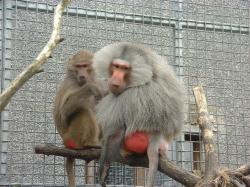 Tom, a baboon rescued in October '05 from a street cage in Beirut, where he had spent most of his five years alone, was given a home at the Cefn-yr-Erw Primate Sanctuary in Wales in January 06. Within a week, in his new purpose-built quarantine accommodation, he was starting to play and building up a bond with the staff there. He was not, however, very happy with the attentions of the vet, but they managed to have him medically checked, microchipped and vaccinated.
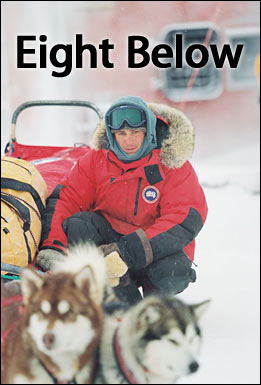 The event upon which this film is based took place in 1958, when a Japanese sled with two humans and nine Sakhalin huskies was trapped by a fierce Antarctic storm. The humans unleashed the two lead dogs, Taro and Jiro: "Go get help, boys!" They ran fearlessly into the storm, found the rescue party, and led them back to the stranded sled. They out-Lassied Lassie. And what was their reward for this remarkable act of heroism? Why, to be abandoned on the world's most desolate and dangerous continent, of course. The humans were evacuated, the dogs left behind.
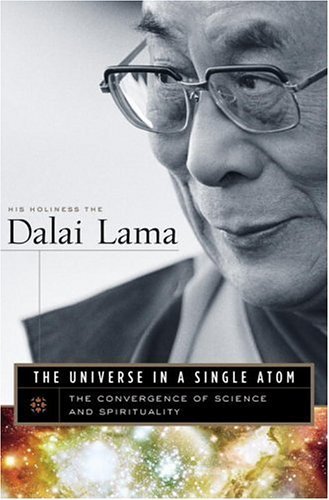 The author of this book is for millions of people the living embodiment of Eastern spirituality, so it may come as a major surprise to its readers that as a teenager he once took a car for an unauthorized joyride, just as your average American boy might do, and damaged it. But there are major differences: the car was one of only three in the whole vast land of Tibet, and he was able to use his ingenuity to cover up the damage. (It usually doesn't work, kids!)
  Most readers of The Peaceable Table know that dairy products (especially the hormone-laden ones produced today) are bad news, both for human consumers and for the suffering cows and calves from which they are forcibly taken by our factory-farm system. Concern for our own health and compassion for our fellow beings motivate many of us to speak up about this situation.
 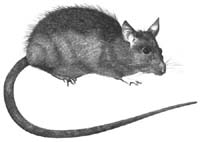 One potentially powerful means of breaking this block and beginning to open minds has recently become available. But it is morally questionable. I have in mind the eye-popping results of experiments by T. Colin Campbell and colleagues of feeding casein, the principal cows' milk protein, to carcinogen-exposed rats and mice, experiments described in Campbell's book The China Study (2005). Campbell found that when the rodents were fed a diet containing 5% casein, cancers scarcely took root, let alone progressing, and all the rats and mice had sleek fur and bright eyes, exercised voluntarily, and lived their full life spans. But of the ones fed a 20% casein diet, all were dead or dying within half that time. The researchers even found that when the percentage of casein was increased for two weeks, or decreased for two weeks, the growth of the cancers would correspondingly speed up or slow down, even stop. Vegetable proteins did not have this effect, even when fed at the 20% rate; it was only animal proteins that did it. The amount of casein given was not astronomical, as with many such experiments, but within the range of human dairy consumption.
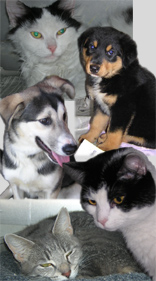 There is much controversy concerning vegetarian diets for companion dogs and cats. Many can agree that dogs are omnivores and can be successfully fed a vegetarian/vegan diet, but most will vehemently voice their conviction that cats are carnivores. End of discussion! Before continuing, let’s remember how vegetarians were once told we would become weak and ill without meat, and on occasion still are told that we must carefully combine our foods if we are not to wither from insufficient protein. Misunderstanding about nutrition and vegetarianism is still prevalent in our society. I am amazed how many Americans skeptically regard vegetarian meals while continuing to consume meat in the face of threatened mad cow disease, heart disease, and colon cancer. Let’s put the suspicion aside and look at some facts which suggest that companion dogs and cats can happily and healthfully eat a vegan diet.
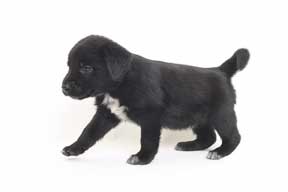 In taking action to make a transition that impacts the lives of others, it is important to make sound decisions. Sometimes the best way to learn how to do something is first learn what NOT to do. This can be very helpful in helping carnivorous cats and dogs transition to a healthy vegan diet.
 After obtaining information, buy some vegetarian/vegan dog food. Introduce the food by mixing a small amount with the "old" food and adjusting the proportions over a period of days. Watch for any signs of gastro-intestinal upset; monitor stools, temperament and behavior. Be positive and help your companion dog know that this is a good thing. If your dog refuses, try different brands. But if it ever becomes a battle of wills, the dog must not become the loser. Companion animals depend and trust caregivers to provide food, care and love. Be patient and work with the dog.
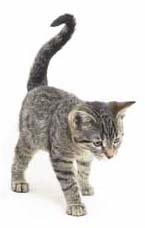 Cats may need a little more work to convince them that it is not necessary to eat a meat based diet. In my search for a safe vegan cat food, I have found only one. It is manufactured by Harbingers of a New Age, Vegecat™ and Vegecat pH™. The supplements can be purchased on-line at a few websites such as
 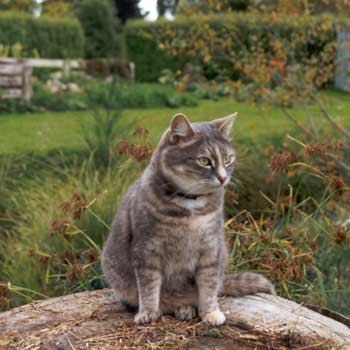 Do not do anything that you feel is ethically or behaviorally wrong. Seek more information.
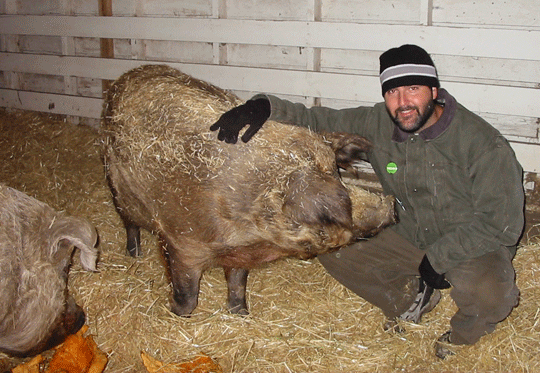 In my childhood I loved spending summers on my grandparents' farm. I remember waking up to roosters crowing and the wonderful aroma of Grandma's breakfast wafting upstairs. I'd rush out to help Grandpa feed our 40 sheep, two steers and the 50 or so pigs. The farm had changed over the years. The gigantic red barn that had once housed dozens of dairy cows now . . . echoed with the calls of the sheep and steers. Grandma collected the eggs from the 50 or 60 chickens and washed them--ready for her homemade delicacies and for neighbors to buy a few dozen at a time.
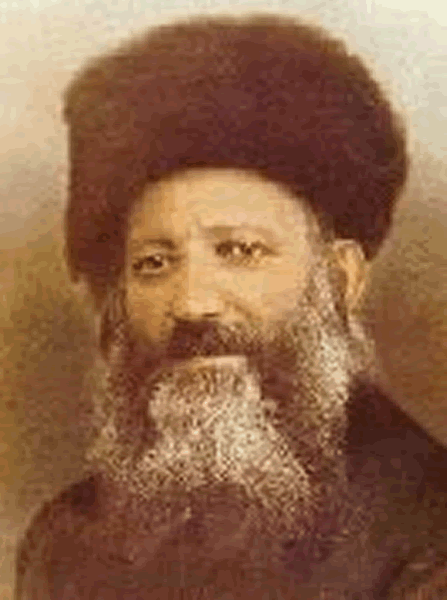 Abraham Isaac Kook (1865-1935), the first Ashkenazi chief rabbi of pre-state Israel, was a Lurianic mystic whose thought focussed on the divine Light that fills the world, the human blindness and evil that ignores and opposes it, and on the process of spiritual evolution by which God sheds abroad ever new dimensions of Light. Sometimes the very appearance of new Light seems to stimulate evil to greater activity, says Kook. But he was convinced that God’s love would not be thwarted forever; eventually it will prevail, and all beings will be completely open to it.
 The sun descending in the West,